Wednesday, April 24, 2013

Water Innovation


This is a video about a billboard that produces drinking water from the humidity in the air.  I am all for water innovation, and I hope this idea continues to be developed!  But, let us do a little quick math together.

One billboard produces 9,450 liters of water in three months.

That is about 105 liters a day. (Not accounting for any of the water spilling etc.)

In many relief and development contexts it would be ideal to provide 15-20 liters of water per person per day, but that includes water for bathing, cooking, washing clothes and dishes, etc.  For just drinking and some cooking you would want to provide at least 2.5-3 liters of water per person per day.

Since in the US most people are unfamiliar with liters, keep in mind, the average soda bottle is 2 liters and below is an image of a 20 liter jerry can.


So getting back to the math, the billboard can provide 7 people with 15 liters of water per day or 35 people with 3 liters of water per day.

Of course, I am totally unfamiliar with the context.  I don't know the typical local water usage per family.  I don't know what other sources of water are available. I don't know how they use the billboard water in comparison to how they use the well water.

My main question stems from the fact that the video implies they are able to provide for the water needs of hundreds of families.  But when I heard the numbers, I had to wonder how they are able to achieve that with only about 105 liters per day (a little more than 5 full jerry cans).

I had a chemistry professor as an undergrad who was a strong advocate for quick mental math and the memorization of estimates for key values in science.  He argued that as good scientists and engineers we should be able to hear a speaker or read an article and quickly consider whether their argument was reasonable based on the values they were presenting.  I have come to see the wisdom in his teaching methods.  I must admit that I have forgotten a lot of the estimates he asked us to memorize and I'm no longer as quick as I used to be with mental math, so please feel free to point out any mistakes I make.  =)  But I have become pretty familiar with basic numbers when it comes to providing safe drinking water.  So when I watch a video like the one above, I can quickly come to my own conclusions.

There was a time when solar panels were at this stage of development as well, and now they are used all over the world.  So I really do hope that engineers around the world continue to innovate and develop new ideas like providing drinking water from a billboard!

Sunday, April 21, 2013

Color!


Apparently I like color. =) 

And I know my outfit doesn't exactly match, but I was determined to wear a spring outfit and fun colors even though it is still kind of cold in Philly. 


This is the day that the Lord has made;
    let us rejoice and be glad in it.
~Psalm 118:24


*Photos taken at Philadelphia's Magic Gardens on South Street

Harvard International Development Conference

Last weekend I was in Boston with several of my classmates for the International Development Conference at Harvard.  Of course the events of that Monday have dominated the news around the world for the last week.   Friends of mine have expressed their thoughts on the bombings on their own blogs, so if you are interested, check out these two posts.  I will only be sharing about my weekend and the conference.

ParadoxUganda: Not Quite at Home

Kriegers Living on Grace: Boston

As a budget traveler, I am so thankful for the hospitality of my friends in cities around the world.  Boston was no exception.  I was welcomed into the apartment of a dear childhood friend late on Thursday night.


Friday was a gloomy cold day, but I was determined to see some of Boston.  So despite the rain, I walked a most of the Freedom Trail.  It was a great way to get a sense for the city and see some historic sites. 


*St. Francis of Assisi statue that was part of the Old North Church*

The conference started Friday night and continued all day on Saturday.  I had the opportunity to hear many influential voices share their thoughts on the future of the development industry, local ownership, climate, the role of government, etc.   I was really thankful for the opportunity to consider a different perspective, since many of the speakers came from bilateral or multilateral agencies (IMF, USAID, World Bank, UNDP, etc.) or have been advisors to presidents of countries around the world whereas many of the students and professors at Eastern University are more involved in grassroots ministries, local churches, and NGOs.  

The conference had several interactive workshops and two case competitions.  I had the opportunity to participate in the case competition on South Sudan, and my team won!  As they were presenting the awards, one of the judges quipped that we had 3 minutes to present an intervention that we had developed in only 30 minutes to address a problem created over more than 30 years of conflict.  Of course our hastily composed intervention developed by graduate students from all over the world (but none from South Sudan) in the halls of Harvard, worlds away from the streets of Juba, is not the way to go.  But it was a fun exercise, and I got a certificate and free water bottle and flash drive out of it.  


My two main thoughts at the end of the conference were:

1. I understood most of what the speakers were discussing which means I have learned a lot of the last year.

2. I am thankful that God brought me to Eastern University.  It is the right program for me.

Monday, March 25, 2013

From Guns to Coke Bottles


This article caught my eye this morning for two reasons: 

1) I have a fascination with Mozambique even though I have never been there 
2) In one short article, the author manages to hit several of the major themes covered in Economic Development last semester  

After reading the article, one line stuck with me.  

"But now the walls bear images, not of clenched fists or of AK-47s, but of the ubiquitous Coca-Cola bottle, or of smiling faces boasting the virtues of one or other mobile phone company."  

It reminded me of this verse from the book of Isaiah.  

They will beat their swords into plowshares
    and their spears into pruning hooks  ~ Isaiah 2:4 

*Sculpture titled Let Us Beat Swords Into Plowshares at the United Nations Art Collection* 

Personally, if I were to repurpose a metal symbol of destruction, I'd make it into a water tap.  =)

I have been thinking a lot about the importance of symbols in communities, especially since I was assigned to do a group presentation on symbolic interactionism for my Community Development class last semester.  

So today the article has me considering symbols of peace and prosperity in different times and worldviews. Rather than try to express those thoughts in written form, I will just leave it as an idea for you to ponder.  


*RAWTools turning weapons into farm tools - These guys spoke briefly at the Justice Conference*  


Friday, March 22, 2013

World Water Day


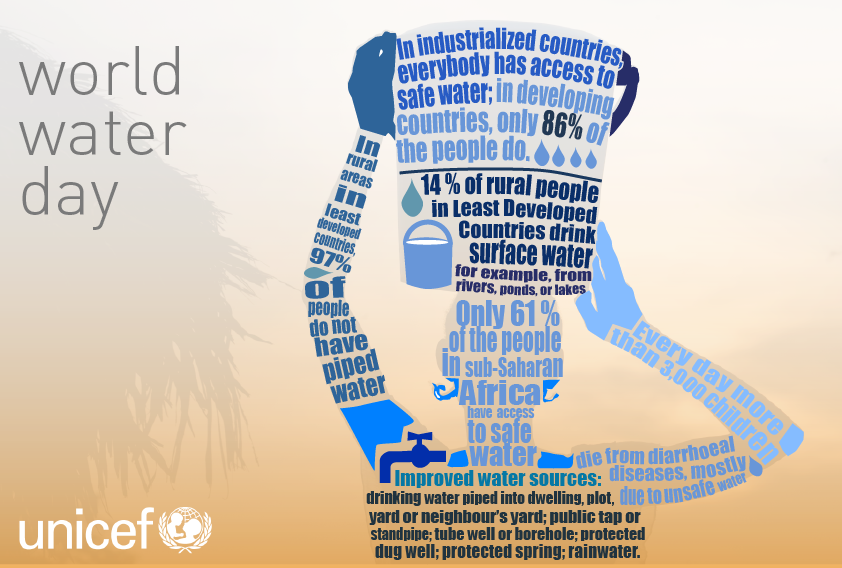
Today is World Water Day! Since I have spent a lot of time thinking about water, here are a few things I would love for you to think about today.

For many people around the world, getting water is HARD WORK! Water is heavy (about 8.3 lbs per gallon varying slightly with temperature and pressure).  I tried a couple of times to carry water on my head, and only managed to carry the smaller size jerrycan (10 liters) a relatively short distance.  People around the world work hard for their water while we just turn on the faucet.  And the majority of the people gathering and carrying water are women and children.

Add to that the work of accessing an improved a water source, well you get the idea.  I posted this picture because I think it shows visually some of the work involved, but let me tell you that digging trenches through the hard S. Sudanese soil is the really hard work.  It just doesn't make for as dramatic of a picture.


In my Relief and Disaster Mitigation class we studied the Sphere Handbook.  It provides minimum standards as well as indicators for humanitarian response.  In practice, the indicators often serve as goals for different sectors when responding to emergencies.  Just to give you a sense of scale, in a refugee camp the water goal is 15 liters per person per day and no more than a 30 minute wait at a tap.  The typical large jerry can shown below holds 20 liters of water.  I took this picture on the day of a convention at the ECS church in Mundri which meant extra long lines and water shortages in the system.  This was an unusual day in Mundri town, but many disaster response situations will not even achieve the goal of 15 liters per person per day for drinking, hygiene and cooking.  I've seen different numbers floating around, but it is no secret that Americans use a lot of water every day.  Since I'm talking in liters, the average person in the United Kingdom uses 150 liters of water per person per day, ten times more than the goal for disaster response.


Even though I am no longer serving as a water engineer, I will always care about water issues.  I hope today you consider the water you drink and pray for those who don't have access to safe drinking water.  Pray especially for individuals affected by disasters and conflict who are living in camp situations where water is often very scarce.  

Wednesday, March 20, 2013

Back to Mundri!


It's official! Or as official as it is going to get until I work through details and paperwork with WHM and Eastern which could take a while.

I'm heading back to Mundri for about 7 months for my field practicum, which will complete my MA in International Development from Eastern University! 

I get different reactions when people hear that I have lived in South Sudan and that I am heading back.  A lot of people are surprised and ask me why I am going.   

I have heard all of the reasons I shouldn't go.  In fact, I have considered many reasons that will never even cross your mind.  I have counted the cost.

I am not a unique person who doesn't like stability and comfort.  I have spent a lot of my life traveling and moving, but I still long to be a part of a community of friends that is steadfast and unchanging.  Even if I lived my whole life in the same small town, things would change.  The only truly steadfast person in my life is God.   

I am going back to South Sudan. Not because the cost is small.  But because of the one who paid the cost I could never pay on the Cross.  Not because I made and impulsive thoughtless decision.  But because of the call from God that I have doubted and prayed over repeatedly.  Not because I'm a special person who finds the life of a missionary easy all the time.  But because of the one who carries my burdens and gives me strength. 

I could come up with a million reasons not to go including the fact that I am not guaranteed success in ministry.   Missionaries are definitely not granted an easy button for life from God.  But I truly love partnering with Christians in Mundri and seeing God at work in a place that is now a part of "home" for me.  Some days things will be really hard and there will be sacrifices, but I can tell you first hand that there is also tremendous joy in the missionary life.

So I'm headed back to Mundri, and if you wanted to know why, I hope this post helps you understand a bit more of the answer to a question I struggle to answer myself some days.


Tuesday, March 19, 2013

Airport Ads and Reminiscing


I spend a lot of time at airports.  Before a long flight I tend to wander the airport just so I can move my legs in anticipation of the hours of sitting ahead.  While waiting for flights I get to see a lot of airport ads.  I always look for the HSBC ads which are usually clever.  This campaign in particular made me smile.  First, as a student of international development, I agree that local knowledge is immensely important.  But mostly, it sounds like a Michael-ism.  "Never underestimate the importance of local knowledge" fits right in with "never underestimate the power of the equatorial sun to reduce productivity" and "never underestimate the usefulness of a short length of pipe" and all the other valuable lessons Michael taught his engineering apprentices.  Michael usually shares those pearls of wisdom after singing the following lyrics.

"I have only come here seeking knowledge, things they would not teach me of in college" ~ Wrapped Around Your Finger, The Police  

And I definitely learned a lot of things not taught at Penn State!  Before starting on our first water tower, Michael had me practice with Kyle by making a work bench.  Kyle and I planned, discussed, measured, and cut the angle irons with a hack saw.  As we were getting ready to weld them together, we realized that even with two engineering degrees between us, we had still cut every angle iron on the wrong plane creating spear like pieces. Good thing Michael had us practice first! Now you know why Michael kept singing those lyrics.  I definitely lacked practical skills when I arrived in S. Sudan.

So now back to the airport ads.


Recently, I have also taken notice of the strange but humorous Oxfam ads.   Since I'm guessing you can't read the small text, it reads "unique gifts that help fight hunger, poverty, and social injustice."

So next time you are at the airport, walk around and check out the ads.

And if you want to realize how little you know and what it means to minister from weakness, apply to be an engineering intern in Mundri.  You will learn from the men of the local water office, your teammates, and lots of other amazing people in Mundri town.  You may even get Michael to sing you those lyrics!

Saturday, March 2, 2013

Brazilian Treats

Many of my all time favorite foods are all Brazilian.  First of all Starbucks in Brazil came up with the brigadeiro frappuccino!!! AMAZING!!! Although I must say the conversation with my aunt was better than the drink itself. =)


Of course I stopped for pão de queijo. =)


So far I have also enjoyed passion fruit mousse, goiabada with queijo mineiro, guaraná, and AMAZING coffee!!! I have a whole week left of all my favorite special treats that are only available in Brazil (and some parts of South Florida).  These foods remind me of family and bring back a lot of good memories.  Good thing I am only in Brazil for a little over a week because I may be physically unable to pass a shop that sells pão de queijo without buying one.

My Little Blue Dress


On Black Friday 2011 Melissa found a great little blue dress with a bright colored flower print in a pile of clothes like the one shown above in Mundri, South Sudan while we were out doing our team Christmas shopping.  I bought the dress for a few S. Sudanese pounds.

The dress was made in Vietnam and then made its way to a clothing rack at an Old Navy in the US.  It was purchased and then somehow made its way to East Africa.


I wore the dress for Thanksgiving 2012 on Staten Island with a cardigan and tights to help it make the transition from summer to fall.


Now the dress is with me on spring break in Brazil airing out on the balcony of my aunt and uncle's apartment after a long flight in a suitcase.  Who knows what other travels are in store for my little blue dress.


Sunday, February 24, 2013

Justice Conference


PhillyBloco performed! They are a Brazilian music and dance group with lots of energy and drums.  The convention center wasn't a great space for them, but they still got people dancing and enjoying the music.  I've seen them live in a smaller venue, and they are great live!


But I didn't go to the Justice Conference for the music.  I went to primarily to connect with people and secondly to hear some great speakers.  The highlight of the main conference speakers for me was a panel discussion which included Dr. John Perkins and Lisa Sharon Parker who is shown on the screen in the above picture.  Personally, I enjoyed the depth and thoughtful reflection of the discussions at the pre-conference breakout sessions more than the dynamism of the main conference speakers, but there was a lot to consider and learn throughout the whole conference.

So here for your consideration are a few thoughts presented by the speakers that I am still pondering.  Since I was scribbling notes quickly, I can't guarantee that these are direct quotes, but I'm hoping they are close or at least capture the speaker's point of view.

1. Dr. Nicholas Wolterstorff - None of the current writings on justice start from the wronged.  They start from the intellectual puzzles.

2. Dr. Nicholas Wolterstorff - We will get all mucked up if we start with the gray cases, so start with the easy and then get to the gray ones.

3. Dr. Nicholas Wolterstorff - Justice at many points requires freedom, but freedom without justice is only for the powerful.

4. Dr. Soong Chan Rah - (In many cases) Incarnational ministry has become a way for us to become the Messiah.  We empty ourselves to go to the poor to bless them.

5. Dr. Soong Chan Rah - Lament relies on God's sovereignty and not our ability.

6. Dr. Soong Chan Rah - It is our responsibility to lament.

I haven't watched this video, but from the description it seems like it may be similar to his breakout session talk.


7. Ken Wytsma - Quoting Eugene Peterson - You can't hurry lament.

8.Gary Haugen - Do-gooders show up late and leave early.  Perseverance is necessary.

9. Gary Haugen - ...the hidden glory of a long and faithful love

10. Gary Haugen -  Love that overcomes monotony and tedium (and frustration).  This is the love our Maker sees and honors.  A long obedience in the same direction.

11. Gary Haugen - ...ordinary unglamorous work of justice

12. Gary Haugen ... prayer not as a matter of discipline but desperation

13.Gary Haugen - The book of justice is long and boring...I love it when we read it together

14. Dr. Nicholas Wolterstorff - True love is never unjust.

15. Dr. John Perkins - The church lives out its call most fully when it is a community of faith with arms wrapped around a community of pain.

There were a lot of other great things to ponder, but those were just a few that I thought I would share with you.

The BEST part of the conference was the opportunity to connect with friends.  I had many great conversations between sessions and at lunch catching up on life and discussing the thing we heard from speakers.